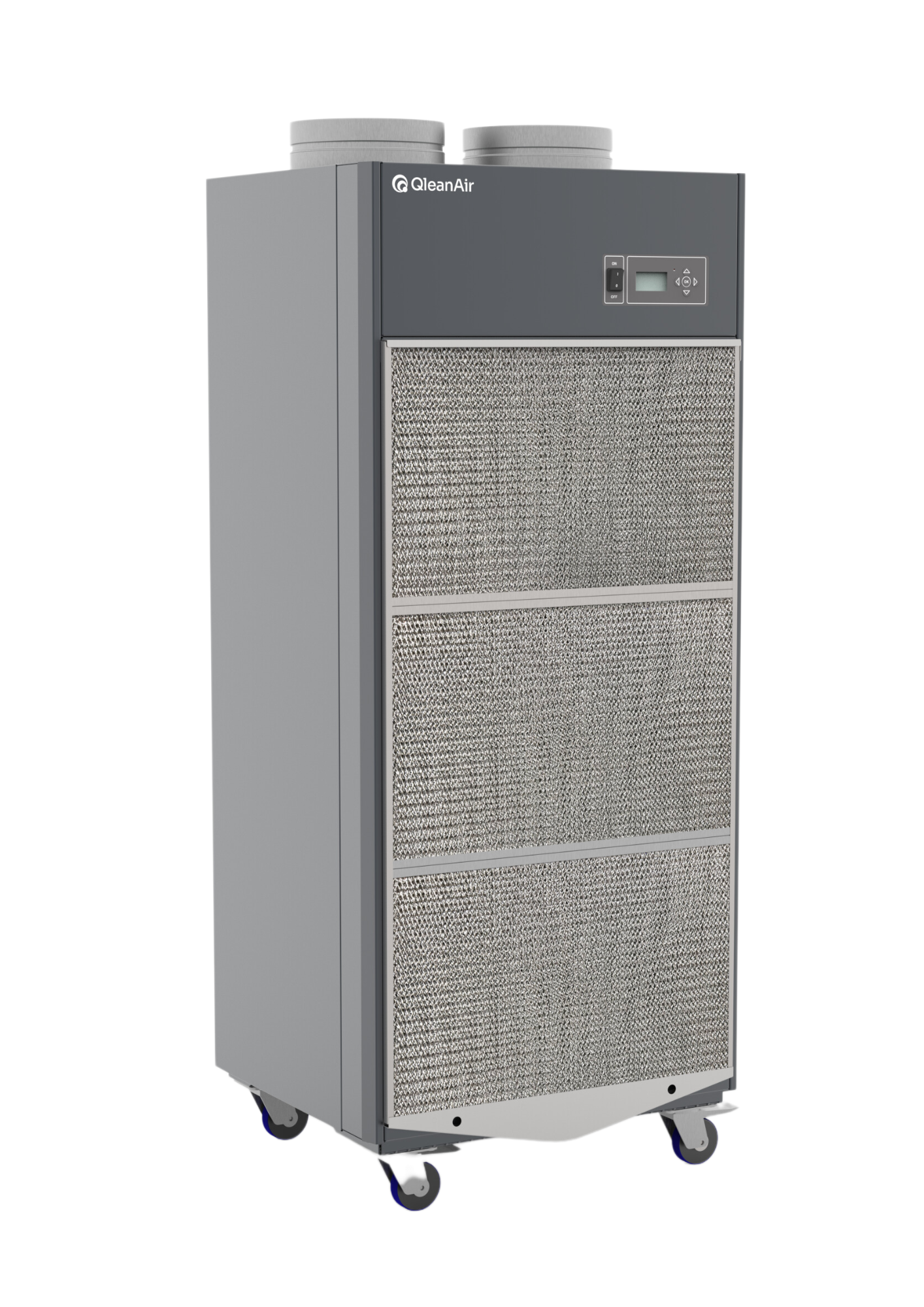
In the metalworking industry, airborne contaminants such as welding fumes, grinding dust, metal particles and oil mist are generated during daily operations. These contaminants can affect workplace safety, employee health, product quality and production efficiency. At the same time, many manufacturing companies face increasing demands for productivity, energy efficiency, stricter exposure limits and attractive working environments. In this context, indoor air quality (IAQ) has become a key consideration. To create a safe work environment and an efficient production environment, a combination of ventilation, source capture extraction and industrial air cleaning is often required.
What Is the Difference Between Ventilation, Source Capture Extraction and Air Cleaning?
It is easy to view all equipment that manages indoor air quality, IAQ, in an industrial facility as one single solution. In reality, however, these are three different systems with three distinct functions.
Ventilation Forms the Foundation of Every Industrial Facility
Ventilation provides the basic conditions for a healthy and functional indoor environment. It supplies fresh outdoor air and helps maintain control of the overall indoor environment from perspectives that extend beyond airborne particles, including oxygen levels, temperature, humidity, carbon dioxide concentrations, as well as the presence of gases and odours. However, ventilation alone is rarely sufficient to effectively manage strong, localized sources of contamination within a facility.
Source Capture Extraction Removes Contaminants at the Source
Source capture extraction, also known as process ventilation, is designed to capture contaminants directly where they are generated. These contaminants may include welding fumes, grinding dust, metal particles, oil mist or other emissions from manufacturing processes. By capturing contaminants before they reach the operator’s breathing zone or spread throughout the facility, source extraction is often the most effective measure when a process generates significant amounts of airborne pollution.
In welding applications, a dedicated welding fume extractor is an important part of an effective solution for capturing welding fumes at the source. In facilities using CNC machinery, a machine-mounted oil mist collector plays a critical role in controlling oil mist and oil smoke generated during machining operations.
Air Cleaning Complements Ventilation and Source Extraction
Industrial air cleaning is often used as a complementary solution when airborne contaminants continue to circulate throughout a facility despite existing ventilation and source extraction systems. It can also help companies create a larger safety margin in relation to occupational exposure limits and indoor air quality requirements. Air cleaners may also be used to create cleaner zones in areas where air quality or product quality requirements are particularly high.
By filtering and recirculating indoor air, industrial air purifiers can reduce particle concentrations and improve indoor air quality in an energy-efficient way. Because the air is cleaned and reused rather than exhausted outdoors, valuable heated air can be retained within the facility.
When Is Additional Air Cleaning Needed?
Even in facilities with effective ventilation and source extraction systems, airborne contaminants can spread throughout the workspace and create challenges.
Examples of situations where supplementary air cleaning may be beneficial include:
- When source extraction for welding and grinding is difficult to implement or does not achieve the desired results.
- During CNC machining operations where oil mist or oil smoke is released when machine doors are opened.
- In areas where exceptionally high air quality is required, such as near painting or coating processes where airborne contamination can directly affect product quality.
- In large or complex production facilities where airflow patterns vary significantly.
- In environments where forklift traffic and material handling contribute to dust dispersion.
How Do You Know Which Solution You Need?
The choice between ventilation, source extraction and air cleaning should be based on how contaminants are generated and distributed throughout the facility.
In some operations, existing ventilation may be sufficient. In others, additional source extraction and/or industrial air cleaning may be required to achieve the desired results.
A thorough assessment of production processes, airflow patterns and contamination sources provides the best foundation for selecting the right solution.
The Best Solution Is Often a Combination
A well-designed strategy for ventilation, source extraction and air cleaning delivers benefits that extend beyond regulatory compliance and exposure limits.
It can contribute to:
- More stable production processes
- Reduced wear on equipment
- Consistent product quality
- A safer and more attractive workplace
- Improved conditions for employee wellbeing
QleanAir Scandinavia – Experts in Industrial Air Cleaning
QleanAir Scandinavia is an innovative technology company with more than 35 years of experience developing air cleaning solutions for industrial and professional environments.
Through technical expertise, customer-driven innovation and a comprehensive service offering, QleanAir helps organizations create safer workplaces, cleaner products and more efficient production processes.
Ready to Improve Air Quality?
QleanAir delivers clean air as a service with consultation, installation, maintenance, and guaranteed performance.
Contact us to discuss how we can support your operation and help you secure cleaner air, safer food, and a better working environment.
Contact us