When warehouse and logistics operations are discussed, the focus is often on automation, energy efficiency, and optimized workflows. However, more and more companies are also recognizing air quality as an important part of running an efficient and high-performing operation.
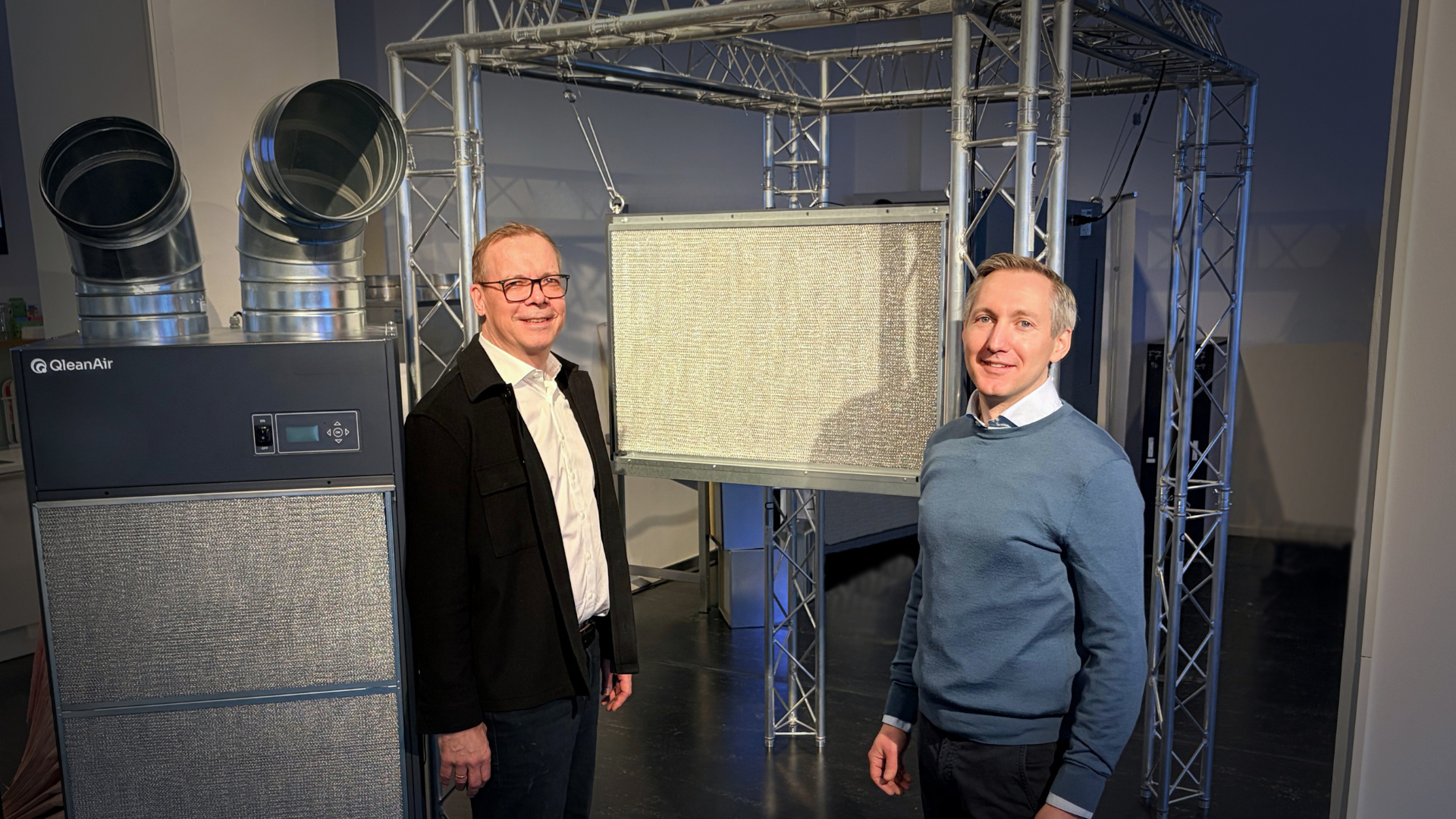
“We are seeing a clear shift where air quality is taking on a more strategic role. Just as companies actively work with safety, energy efficiency, and ergonomics, clean air is increasingly becoming a natural part of developing modern warehouse and logistics environments. The customers we work with recognize the value of clean air, both for the people in the business and for operational efficiency,” says Sebastian Lindström, CEO of QleanAir Scandinavia.
Workplace Environment Drives the Development, but the Benefits Extend Further
For many companies, the journey toward improved air quality begins with the ambition to create a better workplace for employees.
“For many organizations, it is about creating a workplace where people enjoy working and want to stay. As competition for talent increases, the work environment is becoming an increasingly important part of the employer value proposition. At the same time, many companies realize that the benefits of cleaner air extend far beyond the workplace environment,” explains Sebastian.
Operational Reliability Starts with Cleaner Air
Airborne particles affect not only people but also the technical equipment used in modern warehouses. Automated doors, scanners, fire detection systems, sorting equipment, warehouse automation systems, and heating and cooling units are exposed daily to dust that can impair performance and functionality.
As dust accumulates in sensitive components, the need for cleaning and maintenance increases, while the risk of disruptions and unplanned downtime grows.
“It is easy to associate dust primarily with workplace health and safety, but in reality it often affects the entire operation. When particles accumulate in technical equipment, maintenance requirements increase along with the risk of operational disruptions. That is why air quality is also a matter of operating economics,” says Johan Billing, Product Manager at QleanAir.
Cleaner Products and Fewer Complaints
Dust also affects the products stored and handled within a facility. As particles circulate through the air, they can settle on products, packaging, and storage areas, creating additional work and, in some cases, leading to customer complaints.
For businesses with high cleanliness requirements, such as food distribution or medical technology logistics, air quality is often an important part of quality assurance efforts.
Effective Air Cleaning Means Capturing Particles Close to the Source
Standalone air cleaners designed for large warehouses and air cleaners for logistics centers can effectively contribute to improved air quality. To achieve the best results, particles need to be captured where they are generated. In warehouse and logistics environments, dust is primarily generated at floor level, where forklifts, pallets, packages, and everyday material handling continuously stir particles into the air.
“Our studies show that the best results are achieved when particles are captured as close to the source as possible. In warehouse and logistics operations, this usually means at floor level, where the dust is actually generated. That is also why we have worked with floor-standing air cleaners for many years,” says Johan Billing.
At the same time, floor space is often one of the most valuable resources in a warehouse. Operational flows, forklift traffic, and storage areas mean that it is not always possible to position air cleaners where they would be most effective.
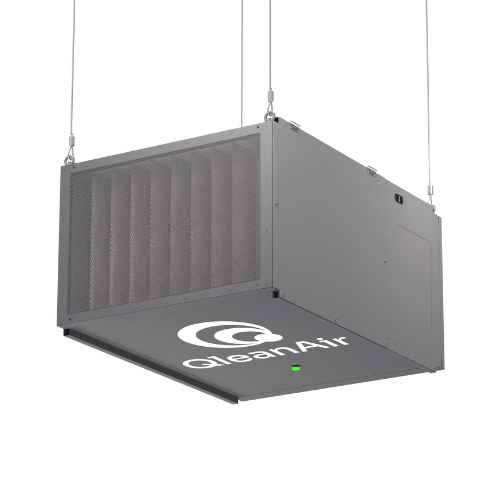
“The objective remains the same: to capture particles as close to the source as possible. Where floor placement is possible, it often provides the best results. However, when businesses cannot spare floor space, a combination of floor-standing units together with wall-mounted or ceiling-mounted air cleaners has proven to be an effective solution. Our experience shows that combining floor-standing, wall-mounted, and ceiling-mounted air cleaners delivers better results than relying solely on ceiling-mounted solutions, as the combination creates better air circulation throughout the facility,” says Johan Billing.
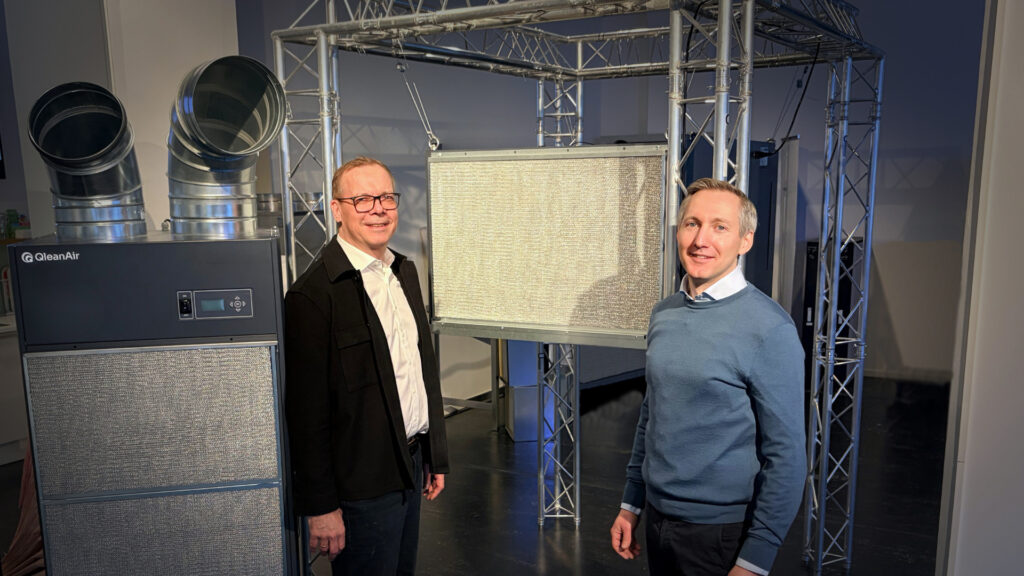
To meet the need for flexible installation options, QleanAir has developed the QleanAir FS 60, an air cleaner that can be mounted on walls, pillars, or ceilings. The FS 60 complements the company’s floor-standing air cleaners and makes it possible to adapt air cleaning solutions to facilities where floor space is limited. Together, the solutions contribute to effective air circulation throughout the entire building.
Air Quality and Energy Efficiency Go Hand in Hand
Interest in the relationship between air quality and energy efficiency is also increasing.
When dust accumulates in heating and cooling equipment, efficiency declines. As a result, systems need to work harder to achieve the same performance, potentially leading to higher energy consumption and increased operating costs.
By reducing the amount of airborne particles, companies can help keep equipment cleaner, reduce maintenance requirements, and create better conditions for energy-efficient operations.
“Energy efficiency is a high priority for many warehouse and logistics businesses today. At the same time, it is easy to underestimate the impact dust can have on technical systems. Cleaner equipment operates more efficiently, making air quality a topic that also affects energy use and operating costs,” says Johan Billing.
In facilities with ventilation systems, air cleaning can complement ventilation. While ventilation manages fresh air supply, humidity, and gases, air cleaning can focus on reducing airborne particle concentrations.
Read more about the QleanAir FS 60 here.
An Issue That Affects the Entire Business
Air quality has traditionally been viewed as a workplace health and safety issue. However, as warehouses become more automated and the demands for operational reliability, energy efficiency, and product quality continue to increase, the topic is taking on broader significance.
“For many of our customers, air quality has evolved from being a separate issue into a natural part of business development. We expect this trend to continue as demands for efficiency, sustainability, and operational reliability keep increasing,” concludes Sebastian Lindström.
QleanAir Scandinavia – Experts in Industrial Air Cleaning
QleanAir is an innovative technology company with more than 35 years of experience in developing air cleaning solutions for industrial and professional environments. Through technical expertise, needs-driven innovation, and a comprehensive service offering, the company helps organizations create safer workplaces, cleaner products, and more efficient processes.