The issue of indoor air quality has emerged as one of the most crucial factors for public health and the modern working environment. New data from the World Health Organization (WHO) shows that global efforts to reduce harmful air pollution have stalled, which has direct consequences for both society and the business community. Despite increased awareness, millions of people are exposed daily to unhealthy levels of airborne particles. For companies and organizations, this means that work to achieve good indoor air quality can no longer be viewed as a mere matter of comfort, but as a strategic health and safety effort. Because we spend most of our working day indoors, the air in our premises greatly affects our cognitive function, our stamina, and our long-term well-being. Actively managing indoor air quality in the workplace has therefore become a central priority for safety representatives, work environment managers, and executive managers.
Global challenges demand increased awareness of indoor air quality
Reporting from the WHO emphasizes that air pollution continues to pose one of the greatest environmental threats to human health globally. The fact that progress has stalled creates an urgent need to examine how environmental factors outside the building affect indoor air. Outdoor air, which often carries combustion particles, road dust, and industrial emissions, is continuously drawn into ventilation systems and spreads throughout offices, warehouses, and production facilities. Without effective protective measures, particles risk concentrating indoors. As a result, workplace air quality becomes a direct reflection of the surrounding outdoor environment, often with the addition of locally generated pollutants such as process dust or particles. Meeting these challenges requires greater awareness of how air moves and is processed in commercial and industrial premises, whether in manufacturing or the service sector.
Why is clean air a crucial health issue?
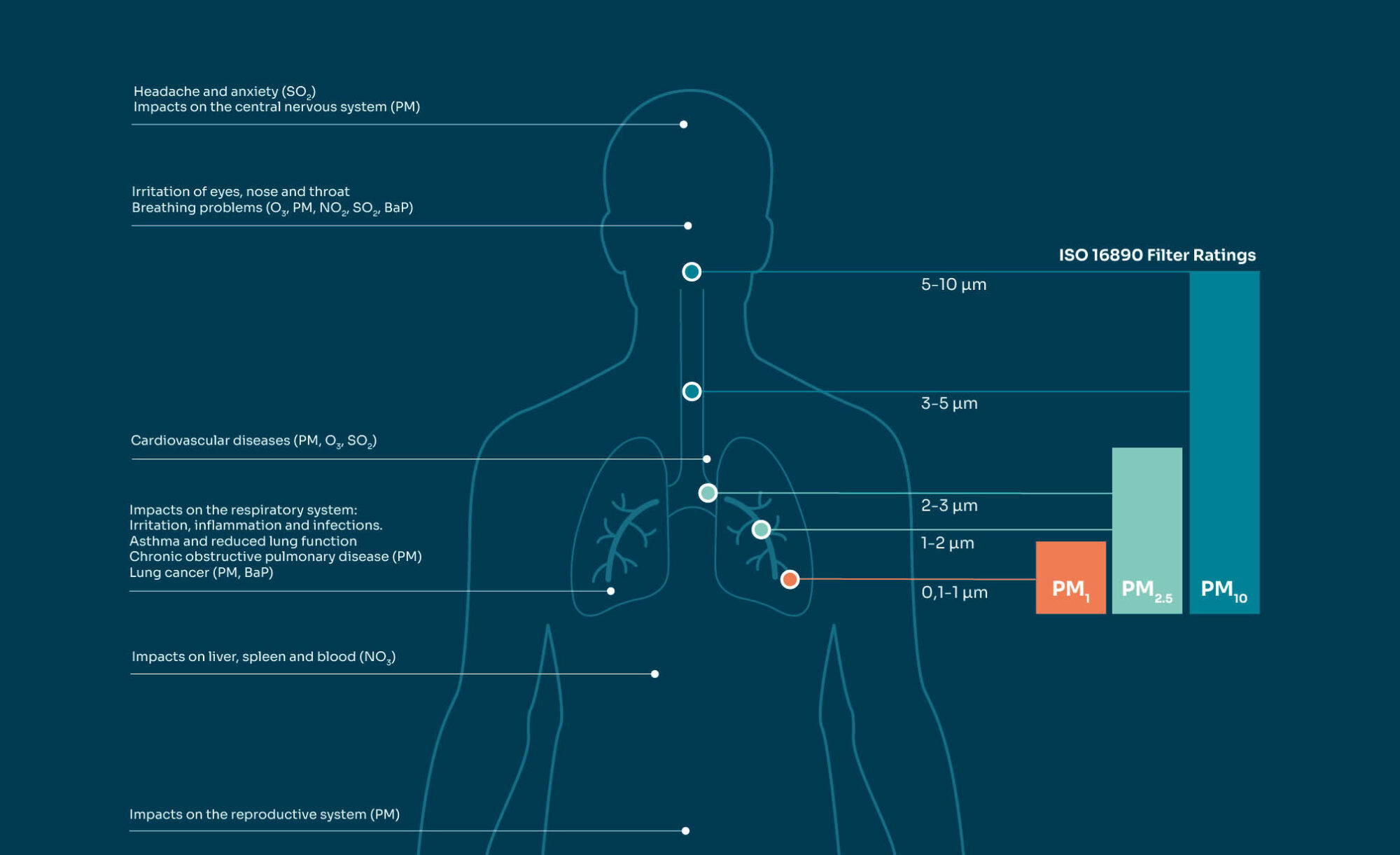
When we breathe in unhealthy air, invisible microscopic particles and harmful substances penetrate deep into the respiratory tract and, in some cases, reach all the way into the bloodstream. It is not merely a matter of visible dust, but of particles so small that they bypass the body’s natural filters. In working environments, these pollutants can originate from mechanical processes, vehicle traffic, packaging materials, or historically also from segregated sources requiring special management, as addressed, for instance, for indoor smoking cabins in specific operations. In the short term, exposure to particles and airborne pollutants can cause eye and throat irritation, headaches, and fatigue. Over time, it can lead to more serious health problems and reduced lung capacity. Clean air is therefore a direct investment in people’s well-being. By eliminating harmful particles, the risk of employees developing respiratory problems and other chronic conditions is reduced. Keeping the air environment clean and balanced creates the conditions for a safer everyday environment where staff feel good and have energy throughout the workday.
WHO data shows stalled progress on air pollution
The latest signals from the WHO are a clear reminder that the issue of air quality requires continuous attention and decisive action. The latest SDG data (June 2026) shows that while global levels of fine particulate matter (PM2.5) decreased until 2020, progress has since stalled completely. In 2023, as many as 6.5 billion people were exposed to air that exceeded even the WHO’s most lenient guidelines (35 µg/m³). The fact that the global rate of improvement regarding air pollution is now standing still shows that property owners and operational managers cannot rely solely on general outdoor measures or basic societal goals.
The effects of poor indoor air quality in professional environments
Indoor air quality is directly linked to how an organization functions day to day, affecting both employee health and business performance.
Risks to long-term employee health
Long-term exposure to dust, fine particles, and other airborne pollutants in professional premises carries significant health risks. When employees breathe in particle-laden air over several years, the risk of chronic respiratory diseases, hypersensitivity, and a weakened immune system increases. High concentrations of invisible particles often accumulate, particularly in industrial environments or facilities with high levels of material handling. Without effective filtration, unintended exposure occurs that gradually degrades health, making continuous air cleaning efforts vital to prevent occupational injuries and long-term sick leave.
Impact on operational productivity and sick leave
Beyond purely medical risks, poor indoor air quality has an immediate impact on work capacity and productivity. Air containing high levels of particles or carbon dioxide often leads to fatigue, difficulty concentrating, and headaches among staff. This slows the pace of work and increases the risk of mistakes. Installing tailored industrial air cleaners significantly reduces the amount of circulating dust and harmful particles. This contributes to lower sick leave, improved well-being, and a more dynamic working environment where everyone can perform at their highest level.
Proactive measures for a healthier working environment
To ensure a healthy working environment, businesses need to shift from reactive measures to a proactive approach. The first step is to carefully test your indoor air quality to map the presence of particles and air pollutants within your premises. Based on this assessment, customized air cleaning solutions can be sized according to the specific needs of the facility. Many organizations choose to sign up for a functional model for clean air as a service, which guarantees continuous operation, maintenance, and optimal cleaning performance over time without requiring large investments. If you would like to know more about how your indoor environment can be improved, you are welcome to contact us for a consultation.